My Adopted Kitties

Showing posts with label cats. Show all posts

Friday, August 10, 2012

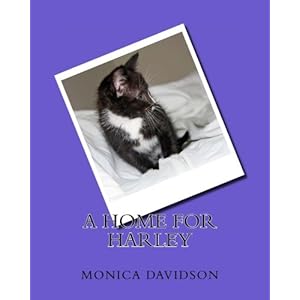
A Home for Harley

I published my first book this week. It's available on Amazon, for only $10. I'm really excited about it. It's a book I wrote for a Writing for Children and Families class at school in 2010.

Here's a synopsis:
"A Home For Harley is a book about Harley, a tuxedo cat, in her foster home. Her foster home is nice, but where will her forever home be?

This book teaches basic facts about cats and the concept of adopting a cat. It also encourages the view of animals as creatures that have feelings and need to be cared for."


I wrote this book as an assignment, inspired by the various pictures I had collected of a foster cat turned adopted-by-us cat, Harley. I really loved it though, so finally, I decided to just publish it.

The book retails for $10 USD, and it is a children's book. Please check it out. 

Thursday, July 28, 2011

A Baby Story


Asleep on Tuesday or Wednesday

Monday (I think)

Today (July 28)

Baby, as we call her, was found on Sunday, July 24, 2011, by a young black man who brought her to PetSmart, hoping to find help for her. He found her in the middle of the road, on a day when the temperature was well into the 90's. She was found to be severely dehydrated, and had a wound (like a hole)on her neck/chin. Sub-q fluids were administered to get her more hydrated, as well as oral fluids. I brought her home, where my fiance (Joseph) and I kept watch over her through the night, as her breathing was very quick and labored, and she also was not drinking on her own and ate only a little food that first night, until we were able to get her to the vet the next morning. The vet prescribed an antibiotic (the first dose given as a shot) to help with the infection in the wound on her neck, cleaned out the wound, and gave her some more sub-q to hydrate her some more. The best guess was that whatever had caused the wound (based on other small scabs found on the body, possibly a dog) had nicked her trachea, as she had air pockets under her skin where air was leaking into her chest cavity and into her subcutaneous layers, leading to a crackling feeling as one petted her, and bubbles of air under her skin. He prescribed an oral antibiotic for use beginning the next day. After the sub-q, shot, and cleaning, Baby was exhausted and could barely stand (courtesy of recent dehydration, an infection, and the stress of having her wound cleaned). I went to PetSmart right after to get some KMR, and Baby wasn't doing so well, she looked tired and was still breathing very hard (around 60 breaths per minute at the vet), and she had me scared there for a bit. After getting what I needed, I took her home and Joseph and I began trying to get her to drink some of the KMR, which she eventually took to lapping off of the end of the syringe we were feeding from. Come that evening, she began drinking milk (warm, of course) from people's hands. She didn't want it in a dish, or from the bottle. So we indulged to get liquid into her. She also began eating wet cat food, slowly but surely. We kept her on nearly 24 hour watch through Tuesday, with only short periods of time of being left alone on Tuesday evening. Tuesday night, we decided she was stable enough, eating enough, to be left alone for us to be able to sleep at a normal time. Wednesday brought Baby eating very close to what the cans of cat food say she should be for her body weight (a whopping 1 lb 7 oz according to the vet), and a much more playful kitty. Baby began acting, slowly but surely, more like a normal kitten. Play hard, eat hard, sleep hard. Her favorite spot to sleep remains on Joseph's lap as he plays computer games, followed by the heating pad we keep running in her room. With Thursday, came much more intense play (longer stretches, more running, jumping, etc.). It was also noticed that the air bubbles, which would have been pushing on her lungs somewhat, making it harder to breathe, had gone away, which basically means that the nick in her trachea must have healed, as the spot on her neck has been doing. Her skin is still crinkley, but I've heard that takes a bit to go away. Her breathing is much closer to normal, and her activity level is much higher. Her gums are much pinker than they were on Sunday/Monday. She loves to climb any and everything, a favorite being jeans to climb up onto higher surfaces. She also likes to sit on shoulders. She has also overcome her fear of that big scary kitten in the mirror which only days ago made her bow up and hiss and turn her tail into a bottle brush. Baby is doing amazingly well, and I would expect her to come away from this just fine. This baby cat found her way to a place where someone would find her (admittedly, not the safest place) and get her help.

A special thanks to Sandy S., Barbara H., and Barbara W. for giving her the boost she needed that day at PetSmart. And a special thanks to Feline Rescue and Rehome for providing for Baby's vet care, and admitting her as a FuRR cat. Hopefully in the not-so-distant future, after Baby is bigger and vetted, she will get an amazing home.

Like many rescues, FuRR can always use donations. If you want to help animals like Baby who need help and need homes, you can donate to FuRR. Visit our website at www.teamfurr.org for more information about us.

Monday, July 25, 2011

RIP Chi-Chi

Chi-Chi a few months before she died (instagram pic)

Right after I got her and her sister, Elsie, in 2006 (Chi-Chi is on the right)

On my bed

The picture my 6 year old sister, Reese, drew to put in her grave with her...


Oct. 31, 2006-July 5, 2011


I miss her. I miss her terribly. Every thought brings tears. I want to remember. I don't want to forget a thing about her. We called her Chi-Chi, but her full name was Chidori, which is Japanese for 1000 chirping birds. When she was little, her meow sounded like birds, and she was very vocal. That changed little as she got older. We adopted her from a lady whose daughter didn't take care of her cats. Her cat had babies, and the daughter had left them there with no food or water. The mother found them, and brought them home to find forever homes. Chi-Chi and Elsie found it with me.
I want to remember how she looked, how she smelled, how she acted. How she slept by my hip. Her meow. The way she loved to be on my shelves and annoy me by knocking things off. The way she loved to drink water from the bathroom faucet and would run me over to get in there in case I turned it on. How soft she was. Her teardrop at the corner of her left eye echoed now by my own.
She died of pulmonary edema and congenital heart failure. There is no official diagnosis of why, but based on some google searches, Joseph and I suspect acute renal/kidney failure. She was too dehydrated for them to get a blood draw, so all they had to go by was the x-ray.
I took her to the vet Thursday because she'd been acting annoying, and peeing outside of the litter box more often than usual. She had no urine in her bladder, so they kept her overnight to get a urinalysis. Friday morning they gave her a medicine called Lasix to make her go pee, and they determined she had a low-grade urinary tract infection (UTI). They gave me a bag of special food for her to eat, and Clavamox for the infection. We took her home, put her in Reese's room, and she turned her nose up at the food, but she was at least drinking some. As Saturday came, and then Sunday, she was still not eating (even wet food I got her) and not drinking without a lot of pressure to. I was forcing some water down her through, but not enough. Monday, she was not wanting to drink or do much of anything. She just did not look well. I kept thinking, well, I'll call the vet first thing in the morning. We got some water in her, and Mom, Dad, and Reese left to go to the movies. Chi-Chi was sitting by Joseph and I and after a while, she got up and went and laid down under the side table. Then she moved a bit of the way up the cat tree, then later a little further. She obviously did not feel good. I gave her her medicine, and she threw it up, along with much of the water we gave her. She was breathing hard, and did not look well at all, so we took her to the Kitty ER. They did all the good for her, but she was a very sick kitty by then. Low body temperature (at least 91*, their thermometers didn't go lower), low blood pressure, dehydration, high respiration, barely responsive. I was told she likely wouldn't make the night. And she didn't. I got the call at 12:09 they were doing resuscitation and did I want them to continue.
The worst words ever are: "Just let her go."
Most of you don't care about all of this, but I am writing this to remember it all.
She loved yogurt. She loved to drink water straight for the faucet. She loved to lie on my bookshelf, and if there was anything to knock over, knock it over. She liked to lie on my jeans on the shelf. She liked to sit under the light on my side table. She slept by my hip. She was incredibly tolerating, and she had recently had become designated "Reese's kitty". She liked to lie on people's laps, and sleep on the back of the couch and the arm of it. She would follow me into the bathroom and nearly kill me by running under my feet hoping I would turn on the water faucet. She loved canned cat food.
She is sorely missed, and currently, my grief has no bounds. I pray it will get better with time, but it's hard to see a positive right now. I hope her last few days weren't painful, even if they weren't amazing. Up the last, she would purr when petted and was very caring. She was the best kitty I could have asked for.
_Written July 5, 2011

Wednesday, June 17, 2009

Declawing

I am personally against declawing. There is one main reason people will usually declaw: it's easier on them because their furniture won't be messed up, and they don't have to worry about being scratched. As a general rule, though, these people in question have no idea what declawing actually is. Ignorance is not bliss. Of course, there are still some people who will declaw anyway, but are these really the people we want owning cats?

Your cat scratches your furniture, so you want them declawed. Get rid of the problem, right? Well, does your kid color on the walls? Cut his hands off, why don't you? That'll get rid of the problem. Okay, that may be a little extreme, but most cat owners consider their cats their children. People buy their cats treats, special beds, lots of toys, enough catnip to get half a neighborhood of cats high, just like what one would buy a child. So, if your cat is your child, why don't you consider its medical care the same? As a general rule, the medical care one performs on a child is not elective, it is for the child's benefit. Why not the same for your cat? Spaying and neutering serves a purpose, and gives a cat a better life. Declawing does no such thing. There is no good reason to declaw, aside from medical reasons, such as tumors and cancer. Cats are declawed because it's easier on the humans.

A rough comparison between humans and cats for declawing is the removal of your fingers from the last joint (the one just below your nail) out to the tip. When a cat is declawed, that is basically what is removed. Obviously, the amount is smaller, because cats "hands" are smaller. Most people who declaw do not know this. They believe a cat is sedated and the claw ONLY is removed. Now, I'm not condemning the people who have done this without knowledge. The vet should have told you this, but it's a relatively easy $100+ dollars. The word "amputation" and "disjointing" and "dismemberment" are not words you're going to throw around for an elective surgery. People tend to react adversely to those words. The claw only cannot be removed, because to remove only the claw would leave the cells that generate the claw intact, allowing the claw to grow back, usually in an unnatural fashion: to the side, top, bottom, etc. So an entire section of bone above the claw must be removed as well to prevent regrowth. It is not like removing a human fingernail.

Cats who are declawed can develop a tendency towards biting, litter box aversion, and general aggression. They don't always, but do you really want to risk a sweet kitty becoming a mean kitty over your furniture? Cats can be trained to not claw furniture, or their claws can be clipped, or there's this awesome thing called Soft Paws (c) that work as something like plastic gloves over the claws. Pretty nifty little invention actually.

Cats also be in pain while healing, as they have a tendency to walk on their "toes", sort of like if you were to walk around in a demi-pointe, on the balls of your feet. Cats walk, more or less, the same way. Now, after declawing, the very ends of their "toes" are missing. I think that would hurt to walk on. Not all cats show discomfort, or at least not discomfort as we recognize it. Cats can't talk and ask for tylenol, sadly. Sure would make life easier. Declawing procedures can also sometimes cause abcesses, and, if done incorrectly, the claws can actually grow back anyway, in a most painful fashion, and the declawing will have to be done again, as there is no other option. It can take up to 2 weeks for a cat to be close to normal after this procedure. Spaying and neutering takes only roughly 3 days.

In fact, in most of Europe, declawing is considered inhumane and is actually illegal. Turkey, parts of Japan, Brazil, Ireland, Britain, Germany, Finland, the Netherlands, Denmark, Estonia, and others all have laws against declawing except in cases where it is of benefit to the CAT, not to the HUMAN. Like medical benefit.

So...is your furniture really worth it?

After all, there are some really nice scratching posts out there, and those Soft Paws come in lots of nifty colors. And there's this thing on TV now, the Emery Cat, which I've never tried out, but it looks really awesome. In theory. As is anything on TV that hasn't been tried out. If anyone has one of those Emery Cats, I'd love to hear how they work. In theory, it sounds really awesome.

Sunday, June 14, 2009

FIV+ Cats

I don't have any, but I understand that there's a lot of ignorance and misunderstandings about cats who have FIV. I had a cat when I was about 6 who was diagnosed with FIV, and he was put down. That's not how it is nowadays. 12 years ago, FIV had a whole different connotation. As I said, I don't have FIV+ cats, but some of our other fosters have experience with them, and we have a few FIV+ cats for adoption (adult cats).

These are FIV facts from the Best Friends Animal Shelter page about FIV.

FIV Facts


1. The Feline Immuno-deficiency Virus is a slow virus that affects a cat's immune system over a period of years.


2. FIV is a cat-only disease and cannot be spread to humans or other non-felines.


3. FIV cats most often live long, healthy, and relatively normal lives with no symptoms at all.


4. FIV is not easily passed between cats. It cannot be spread casually - like in litter boxes, water and food bowls, or when snuggling and playing. It is rarely spread from a mother to her kittens.


5. The virus can be spread through blood transfusions, badly infected gums, or serious, penetrating bite wounds. (Bite wounds of this kind are extremely rare, except in free-roaming, unneutered tomcats.)


6. A neutered cat, in a home, is extremely unlikely to infect other cats, if properly introduced.


7. Many vets are not educated about FIV since the virus was only discovered 15 years ago.


8. FIV-positive cats should be kept as healthy as possible. Keep them indoors and free from stress, feed them a high-quality diet, keep and treat any secondary problems as soon as they arise.


Most FIV cats live long, normal lives, and they can live happily among other cats with no problems, since FIV is not easily spread. They are sweet and want love like any other cat.

Links to our FIV+ cats:
Sparky
Maggie
Dusty Blue

Another good link about FIV cats is here.

I can't guarantee this cats are still up for adoption, but odds are, since they're special needs cats, they are.